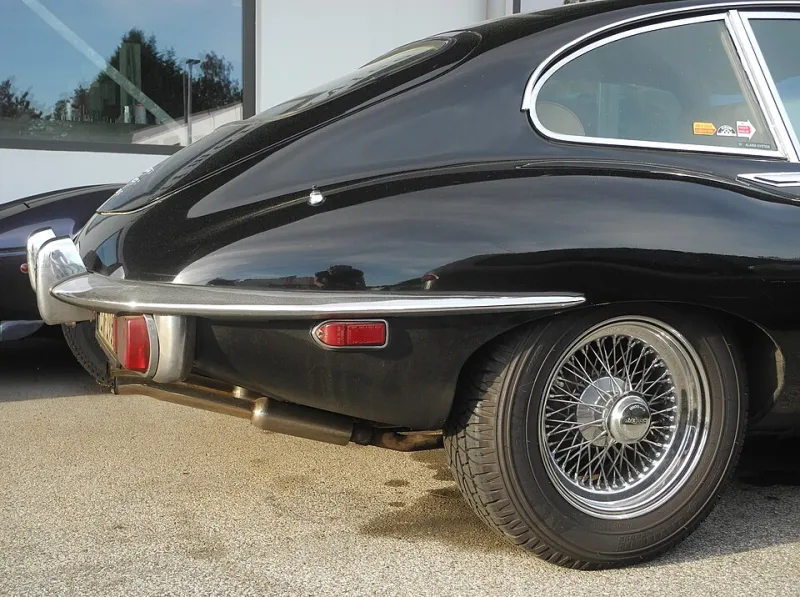
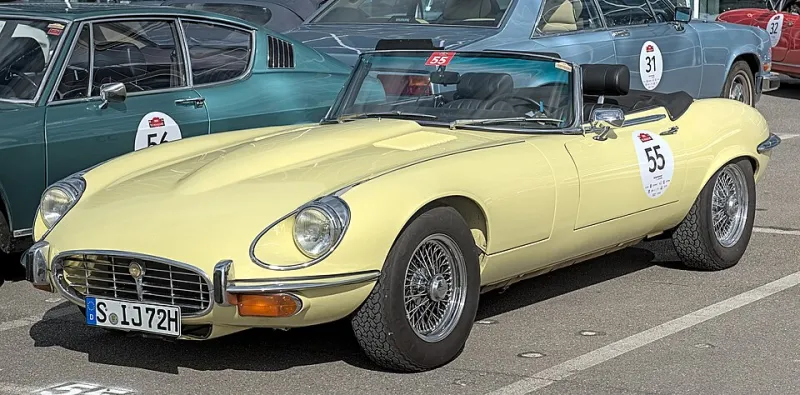
The Rear-End Whodunnit: Tracing E-Type Suspension Noises Without Guesswork

Photo: Ermell, CC BY-SA 4.0, via Wikimedia Commons
The first time you hear a clunk from the rear of an E-Type, it is tempting to reach straight for the parts catalogue. That way lies a scattergun rebuild and a bank balance with a hole in it. Rear-end noises are evidence. The trick is to gather that evidence methodically before you start removing things.
This is not a job for a windy driveway with a trolley jack and a hopeful attitude. You need a safe, level surface, proper axle stands or ramps, a good torch and a pry bar. If you are not confident underneath a car, get help. The E-Type’s rear suspension is robust, but it is also capable of hurting you if you take liberties.
Treat the Noise as Evidence
Before you touch a spanner, describe the noise. When does it happen? Is it a single clunk on take-up, a rattle over rough tarmac, a drone that changes with cornering, or a thump when you go over a speed bump? Does it change with braking, steering or load? A written note on the phone is more useful than a memory of 'something at the back'.
First, a Safe Road Test
Find a quiet stretch of road with a few bumps and some smooth sections. Drive slowly and deliberately. Accelerate gently, then lift off. Brake gently. Turn left and right. Go over a speed bump at walking pace. Listen with the windows down if it is safe to do so.
A clunk on take-up or on/off throttle often points to universal joints or diff mounts. A drone that changes when you load one side can suggest a hub bearing. A rattle over bumps may be exhaust clearance or a tired trailing-arm bush. A single thump over speed bumps can be diff mounts or worn bushes. You are building a picture, not guessing.
Axle Stands and a Good Torch
Get the car safely in the air. I prefer ramps for a loaded suspension check and axle stands under the chassis for a pry-bar session. Never rely on a jack. Once it is up, use a bright torch and look for the obvious: shiny rub marks, perished rubber, rusty dust around joints and loose fasteners.
Universal Joints and Half-Shafts
Check the universal joints at the half-shafts and the diff. With the car in gear and the handbrake on, try to rock the half-shafts by hand. Look for rotational play and listen for a click. Rust-coloured dust around the caps is a warning sign. If the joints have grease nipples, make sure they are actually taking grease. A dry UJ will clunk under load and eventually fail.
Hub Bearings
Grab the top and bottom of each rear wheel and rock it. Then try at three and nine o’clock. Any noticeable play needs investigation. Spin the wheel and listen for a rumble. A hub bearing that is failing often changes tone when you load and unload the wheel by cornering. Do not simply tighten the nut to hide the problem; check the bearing and the spacer arrangement properly.
Differential Mounts and Trailing Arms
Look at the diff mounts for cracks and separation. A pry bar between the diff and the mounting point can reveal movement that a visual check misses. Do the same with the trailing-arm bushes. They should resist movement and look intact, not squidgy or split. Remember that the rear suspension is under load, so check both with the car at ride height where possible.
Exhaust Clearance
This one catches people out. A rattle over bumps is often the exhaust touching the body or the rear axle. Check the full run of the system, especially around the rear suspension and over the axle. A rubber mallet is useful for tapping the system to hear where it contacts. A missing or perished exhaust mount can cause a surprising amount of noise.
The Repeatable Routine
Write down what you find. Fix one thing at a time, then repeat the road test. If you replace every bush and joint in one go, you will never know which one was guilty. That matters for your wallet and for your understanding of the car.
The E-Type’s rear end is not a black box. It is a collection of parts that wear, and each wear pattern leaves a clue. Take your time, use proper support, and let the evidence lead you to the fault. The parts catalogue can wait.