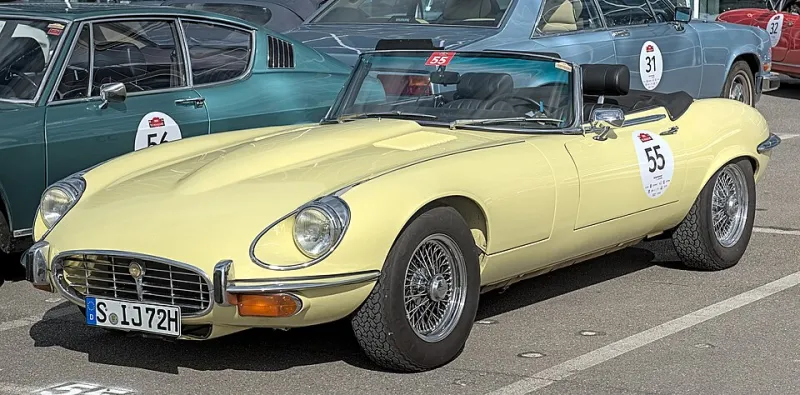
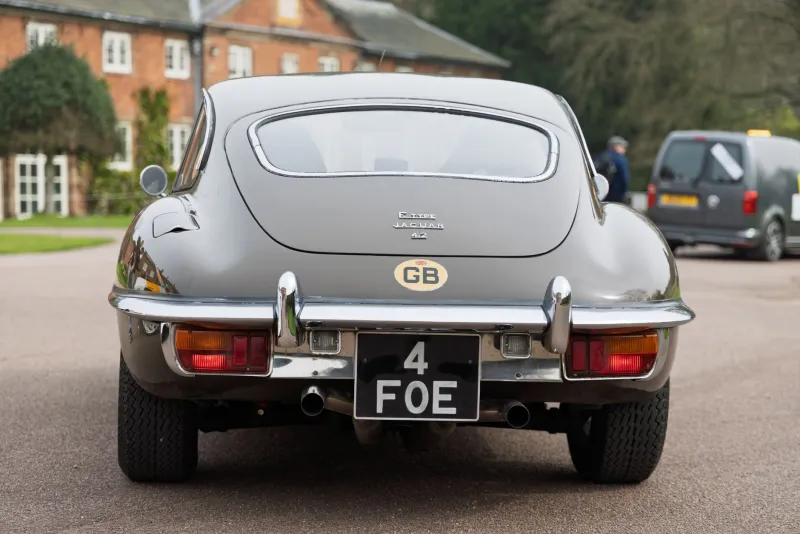
The Wheel Truth: Keeping E-Type Wire Wheels Honest on 2026 Tarmac
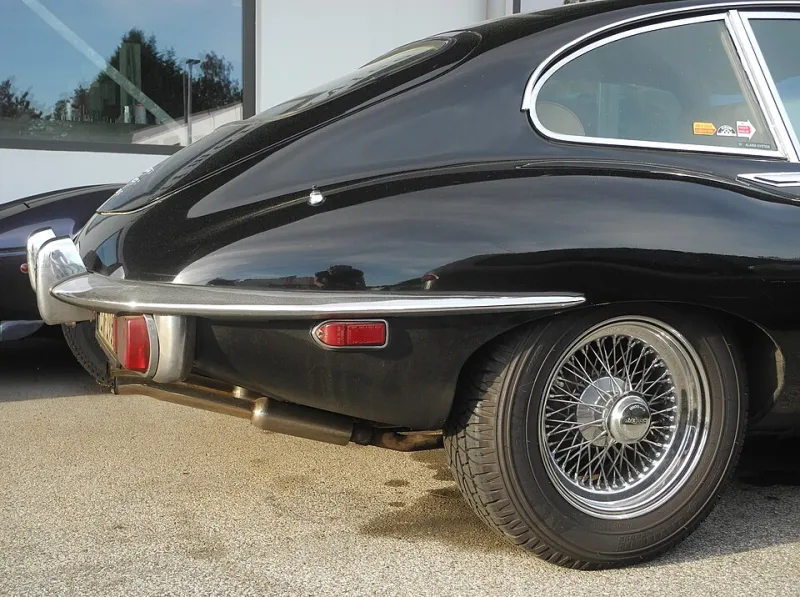
Photo: Im Fokus, CC BY-SA 4.0, via Wikimedia Commons
There is a particular noise an E-Type makes when a wire wheel is unhappy. It starts as a faint tick under braking, grows into a shimmy at 55 mph, and ends with you lying on a cold driveway in November, counting spokes like rosary beads. On 2026's roads—freshly scarred by another winter of freeze-thaw and patch-and-run resurfacing—wire wheels deserve more than a glance at the MOT.
The good news is that most wire-wheel problems announce themselves early. The bad news is that we ignore them because the car still rolls. A wire wheel is not jewellery. It is a consumable, serviceable component, and it will tell you what it needs if you know where to put your hands and ears.
First, the free check: hands, ears and a jack
Get the corner of the car safely in the air and support it properly—no balancing the jack under a wishbone while you lean on a spinner. Spin the wheel slowly and watch the rim edge against a fixed pointer. A zip tie taped to the suspension makes a perfectly good poor man's dial gauge. You are looking for side-to-side wobble and up-and-down hop. A millimetre or two can often be tuned out. A visible wave in the rim is a different conversation.
Then tap each spoke with a small spanner. A healthy spoke gives a clear ring. A dull thud means it is loose, seized or already broken at the nipple. Work around the wheel in sequence and check both inner and outer spokes; the inner ones hide behind the hub and are usually the first to suffer. If you find a broken spoke, stop. A wheel with a missing spoke is not 'fine for now'—it is overloaded everywhere else.
Reading the splines before they read you
The splined centre is where wire wheels quietly die. With the wheel off, look at the hub splines and the wheel splines. They should be square-topped and crisp. If they have gone pointed, hooked or triangular, the wheel is rocking on the hub and no amount of spoke tension will fix it. A worn wheel on a worn hub will clunk under acceleration and braking, and eventually it will chew the hub as well.
Clean the splines properly and inspect for rust and fretting. A thin smear of copper grease is a common workshop habit; too much simply collects grit. What matters is that the mating faces are clean, dry of old hardened grease and free of burrs. If the wheel rocks on the hub with the spinner removed, you have your answer: rebuild or replace.
Runout, runout, wherefore art thou
Truing a wire wheel is not black magic, but it is patient work. You need a spoke spanner that fits properly—not a pair of pliers with ambition—and a way of measuring runout. A dial gauge is lovely; a pointer and a steady eye will do. Check lateral runout first, then radial.
Tightening a spoke pulls the rim toward that spoke's side. So to pull a rim left, tighten the spokes on the left; to push it right, loosen the spokes on the right. Work in small quarter-turn increments and go slowly around the wheel. Never crank one nipple half a turn and hope. If a nipple is seized, use penetrating oil and patience. If it still will not move, stop before you round it off and hand the wheel to someone with the right extractor.
Before you start, check the rim is not cracked around the spoke holes and that the wheel is not badly out of round. A wheel that has been kerbed hard or run with loose spokes for years may be beyond a driveway truing session. That is not failure; that is knowing when to call the specialist.
Knock-offs, tapers and the correct mallet
The spinner is not a wheel nut. It is a tapered seat that centres the wheel, and it only works if the tapers are clean and undamaged. Wire-brush the taper faces, check for galling, and make sure the spinner threads are clean. Use a proper hide or copper mallet—not a steel club hammer—and hit the ear squarely. Check the handbook for which way 'undo' faces on each side; do not assume left is left-hand thread. Get it wrong and you will tighten the spinner until something expensive gives.
Do not whack the spinner while the car is on a jack. Lower it, then final-tighten. After a few miles, recheck. A spinner that keeps coming loose is telling you the tapers or threads are worn.
Bearings and the hub, not the wheel
A wire wheel has no bearings inside it. The bearings live in the hub carriers, and they are worth checking while the wheel is off. Rock the wheel at 12 and 6 o'clock, then 3 and 9, and feel for play or roughness. Front tapered rollers can often be cleaned, repacked and adjusted. A rumble that changes with speed may be a bearing; a clonk over bumps may be a U-joint or rear hub carrier. Do not replace a wheel because a bearing is tired.
When to rebuild, when to replace
A sound original wheel with tired spokes is often worth rebuilding. Cracked rims, heavily worn splines, severe corrosion or a bent rim usually mean replacement. Cheap new wire wheels vary enormously in quality; a proper rebuild of your original Dunlops may outlast a shiny set of unknown parentage. Ask the specialist what they check, what they replace and what warranty you get.
On 2026's potholed B-roads, the best investment is not a set of show wheels. It is ten minutes with a spoke spanner and a torch before the next blast. A true wheel feels planted, steers cleanly and stops without a shimmy. That is worth more than shine.