Sixteen Feet of Possibility: Setting Up a Single Lock-Up for Real E-Type Work

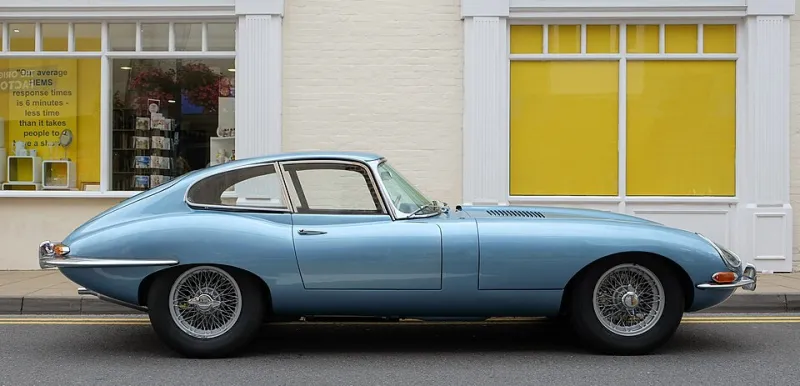
Photo: SharonPapierdreams, CC BY-SA 4.0, via Wikimedia Commons
Nobody restores an E-Type in a double garage with a two-post lift and a parts washer in the corner. They do it in a single garage, twelve inches of clearance down one side, with the doors against the wall and a shelf of jam jars above the bench. If that's your lot, the good news is that a cramped space can be made properly workable. The bad news is that most of the money needs to go on the boring stuff first.
Measure before you buy anything. A standard single garage is roughly 2.5m wide by 5m long; an E-Type is about 4.45m nose to tail. That leaves you maybe 25cm at each end and barely enough room to open a door against the wall. Every decision below follows from those numbers.
Fix the damp before you fix the lighting
Damp is the enemy of a long restoration, and it doesn't announce itself. It shows up as bloom on freshly machined surfaces, as a milky haze on chrome, as rust creeping out from under a new gasket on a shelf.
Start by getting the car off bare concrete — a decent rubber mat or interlocking tiles plus a drip tray under the engine and gearbox. Don't wrap the car in a plastic sheet; that traps moisture against the panels and is worse than doing nothing. If the garage has vents, keep them clear. If it doesn't, a small desiccant dehumidifier with a continuous drain will pull litres out of the air in the first fortnight and then settle into an easy rhythm. A 60cm tube heater on a frost stat costs pennies to run and keeps the worst of the condensation off the tools.
Watch the roof and the door threshold. Water coming in under a garage door travels the length of the floor and finds the sills.
Light: bright, cheap and everywhere
You will spend hours under this car, and the standard single bulb in the middle of the ceiling is useless. Fit three or four 5ft LED battens at around 4000K — neutral white, not the cold blue stuff — and run two of them lengthways down either side of the car rather than across it. Side lighting is what shows you panel gaps and rust shadows.
Then add one good rechargeable inspection lamp with a magnetic base, and one headtorch. The headtorch is the single most-used item in my workshop and it costs less than a decent spanner.
Power you can trust
An old lock-up with a single socket and an extension lead run across a wet floor is how people die quietly. Get the supply checked, insist on RCD protection, and fit sockets at bench height rather than ankle height. If you're renting, a plug-in RCD adapter is the minimum, not the ideal.
Never daisy-chain extensions for a welder or a compressor. If you're running big loads, sort a proper supply or take the welding elsewhere. And put a fire extinguisher — powder or CO2 — by the door, not at the far end behind the car.
Floor, walls and the vertical argument
The floor is where a single garage earns its keep. Bare concrete dusts everything. Cheap carpet soaks up oil and holds damp against the underside of the car. Rubber matting or interlocking PVC tiles wipe clean and are kinder to knees.
Walls are for storage, not decoration. Get one wall entirely into shelving at 1.8m and above, so the car can sit under it. A wheel rack for the spare set, a rack for long timber and exhaust sections, and a bolt board on the wall by the bench. Don't stack boxes on the floor beside the car; that's how you dent a door skin moving past with a jack.
Air and security
Don't run an engine in a sealed garage. Ever. If you need to warm a car up, do it outside the door. A CO alarm costs less than a tank of fuel and is not a joke purchase. If you're welding or painting, you need cross-ventilation and a decent mask — an open door and a fan is the realistic version.
On security: a rented lock-up is a target. Fit a good hasp and closed-shackle padlock, add a ground anchor if the insurer asks, and photograph every tool and the car for the contents policy. Tell the neighbours you actually work in there — a lock-up that always has someone in it is a far worse target than a silent one.
The realistic 2026 budget
| Item | Cost |
|---|---|
| Desiccant dehumidifier (with drain) | £180 |
| Tube heater and frost stat | £70 |
| 4 x 5ft LED battens | £130 |
| Rechargeable inspection lamp and headtorch | £60 |
| RCD adapter and socket tidy-up | £90 |
| Rubber matting or tiles | £140 |
| Shelving, wheel rack, bolt board | £200 |
| Security: hasp, lock, ground anchor | £150 |
| CO alarm and fire extinguisher | £60 |
| Total | About £1,080 |
That's roughly the price of a mediocre respray, and it's the difference between a car that progresses every evening and one that sits under a damp sheet while you find excuses.
What actually changed the room
For me it was the lighting and the floor, in that order. Once I could see properly and stop kneeling in grit, the small half-hours after work started counting for something. The car stopped being a project I visited and became a car I worked on.
Sixteen feet by eight is not much. But a great many E-Types were built to be fixed in less, and the ones that survive are the ones whose owners kept turning up. Make the space easy to be in, and you'll turn up more often.